
Videos
February 12, 2026
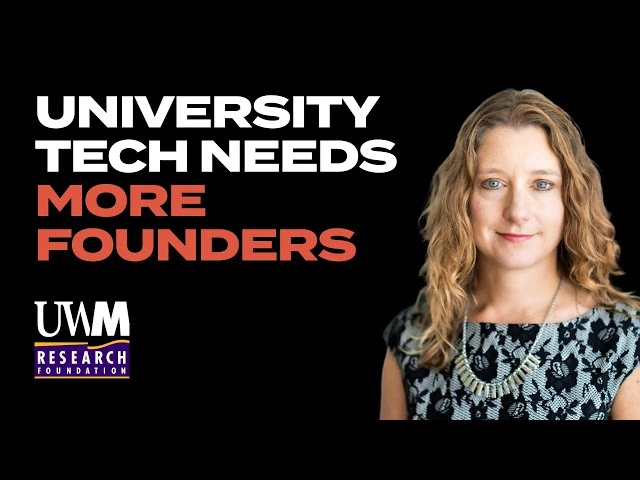
Startup Wisconsin Podcast: Jessica Silvaggi of UWM Research Foundation
Jacob Miller
Become a member & keep reading for free, or choose a paid membership.
Access all our content & email newsletter
This episode of Startup Wisconsin podcast features Jessica Silvaggi, who leads the UW Milwaukee Research Foundation, an organization that exists to help University of Wisconsin–Milwaukee turn university research into real-world products, companies, and community economic impact. She describes their role as the “intersection” between an initial idea and the practical steps required to move it forward.
A big theme is pipeline: 827 submissions received over its lifetime, about 54% have come from engineering, followed by chemistry/biochemistry and others. Jessica says one barrier is simply awareness: many faculty and students don’t realize they have something “disclosable,” so the team tries to get in front of them through class visits, newsletters, social media, and coordination with the Lubar Entrepreneurship Center.
She also talks about “translational” funding: small early checks that create the data needed to attract later capital. The catalyst grant program has run for 18 years, funded by donors including the Bradley Foundation, and typically provides ~$50,000 seed grants. Jessica reports $6.27M granted to date, with projects bringing in $49M additional dollars. Her office has formed 27 startups, and 20 of those received a catalyst grant at some point. A newer bridge grant (launched 2021) has provided $550,000 across 14 startups; she says the first 12 companies they supported brought in about $18M and reported 33 jobs (full- and part-time).
To reduce friction, the foundation also offers “easy button” mechanisms for partnering. Panther Partnering gives companies upfront menu terms to speed sponsored research and licensing decisions. “Express licensing” aims to get startups operating faster by using standardized, fair terms so founders aren’t burning time and money on negotiations and legal fees.
Jessica’s studied molecular/cell biology at University of Connecticut and earned a PhD at Harvard. She joined the foundation early (2009) and emphasizes tech transfer as a “learn on the job” field where trial-and-error and shared best practices matter.
On ecosystem gaps, she says that often the inventor becomes the entrepreneur “by default”. That leaves first-time founders - faculty, postdocs, students - trying to cover CEO, fundraising, pricing, go-to-market, and competitive strategy without the complementary business strengths they need.
Finally, she spotlights some startups: Konovate (battery materials), Deamona Therapeutics (a drug reaching FDA Phase 1), T3 Bioscience (a biopesticide alternative to antibiotics in citrus), Estrogenics Therapeutics (non-hormonal hot flash treatment with memory-loss signals in animal studies), and Rody Medical (an IV tubing organization device already in hospitals).
Jacob Miller, "The Startup Wisconsin Guy" is Marketing & Brand Manager for marketing agency Headway in Green Bay, and State Wide Organizer for Startup Wisconsin a website and event series that digs up the best tech and startup events, accelerators, pitches, and resources in that state.
Trending Stories
Latest Videos

All Rights Reserved
Copyright 2025 Zeroto7 LLC
Powered by: