
Become a member & keep reading for free, or choose a paid membership.
Access all our content & email newsletter
Unless you’ve had your head buried under a rock, you will have noticed that since early last year, there is a constant flow of local news about data centers. These appear to be bigger, and hungrier than ever, as well as seemingly following a checklist: placed in regions with abundant land, with proximity to high-voltage transmission, relatively lower power prices, and access to water for cooling, often being paired to local policies to reduce capital costs.
Likewise, it can’t have escaped even the most passive observer that the Midwest ticks all or most of these boxes. You can even see this on the excellent Data Center Map: where Illinois and Ohio sit just behind California, Texas and Virginia by volume and the Midwest as a region has the largest concentration of anywhere.
In Michigan, lawmakers this year approved sales and use tax exemptions to attract data-center development and suppliers. These moves aimed to reduce upfront costs for qualifying projects and contractors. Information shared by the state frames it as 6% tax relief on eligible equipment and construction purchases, subject to certification. Axios even described it in a story back in April as the “AI boom … reshaping the Midwest from Michigan to Iowa”
But incentives are only part of the explanation of this boom. Regional grid dynamics may matter even more. PJM Interconnection - the country’s largest grid operator, which covers parts of Illinois, Ohio, Pennsylvania and beyond - has seen capacity auction prices spike to record levels according to Reuters, as new demand outpaces actual power generation. Their story also quoted figures from a report by consulting firm ICF, which claimed that residential power bills could rise 15–40% by 2030 if trends persist.
Those numbers help explain why there is also experimentation with new ways to secure cleaner or firmer power, sometimes far from wind and solar clichés.
Flagship builds in and Wisconsin
In Middleton Township, Wood County, Ohio, Meta has committed roughly $800 million to the Bowling Green Data Center, a 715,000-square-foot campus slated to be fully operational in 2027. Officials say the project peaks at ~1,000 construction jobs and sustains about 100 full-time roles with average salaries in the mid-$80,000s. Meta says the site will be “AI-optimized” and powered by 100% clean and renewable energy. Following concerns by local residents, the local government shared an open letter from the company, aimed to answer those concerns.
The ripple effects have been felt nearby. Waterville, Ohio, voted for a 12-month moratorium on the issuance of any permits for data centers, reflecting unease about converting farmland for power-intensive industrial use. Local officials have previously noted that there were no active data-center applications inside the city limits, but neighboring approvals and the Meta campus may have thrust the issue onto local agendas.
Farther north in Mount Pleasant, Wisconsin, Microsoft’s Fairwater campus has become an emblem of the AI era’s scale. Our story at the time said the company claimed the facility was the world’s most powerful AI datacenter and would “house hundreds of thousands of Nvidia GB200 and GB300 GPUs, aiming to deliver performance ten times greater than current top supercomputers” when it opens in the coming months. A second equal-scale campus would take their total, in-state investment above $7 billion by the end of 2028, with 500–800 long-term jobs after construction.
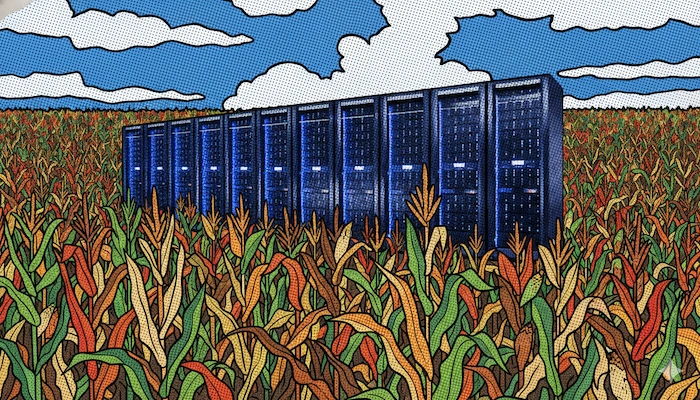
Those two projects anchor a broader regional shift in land use. Rural counties with legacy transmission, lower land costs, and fewer barriers to approval than dense metro areas are now targets for multi-hundred-acre, multi-hundred-megawatt data center “campuses”. That transformation - as well as the potential trade-offs they entail - is at the heart of what makes this a Midwest story.
Jobs vs. land, water, and power?
Wisconsin offers a case study in how data centers are becoming a litmus test for policy-makers and regulators. As large campuses advance, residents and local officials raise concerns about energy and water consumption, grid capacity, and the fairness of state-level tax exemptions for what many see as a highly profitable industry. Environmental groups point to proposals whose electricity demand would dwarf that of entire counties. Economic-development officials counter with the news that exemptions and training partnerships help build a durable jobs pipeline in innovative industries.
Illinois and adjacent states are wrestling with similar trade-offs. Conservationists warn that converting farmland in such a way may effectively be irreversible, as well as reducing open-space benefits like flood protection and carbon sequestration. Utilities and grid operators warn that power and transmission upgrades are inevitable - and expensive. Meanwhile, industry groups emphasize tax contributions, employment, and commitments to procure cleaner energy or adopt water-saving cooling. The clash of narratives - economic promise versus potential resource strain - appears to have become a standing item at county boards and within the halls of state houses across the region.
The grid story is not abstract. Consumer advocates are sounding warnings about a better allocation of costs across these communities. Auction payments - designed to ensure plants are available at peak - have climbed by hundreds of percent in the last couple of years, driven in part by data-center load.
States and utilities are therefore experimenting with programs to shift costs toward the largest users. Ohio already requires data center operators to pay for at least 85% of the energy they contract over long terms, an apparent attempt to reduce the chance of costs seeping into the community.
Nevertheless, potential stresses are visible across the region: heat-driven peaks pushing old infrastructure, delayed interconnections, and significant transmission spend. There is little question of whether or not these investments are needed; this is the future of innovation and our region has a vital part to play. The uncertainty rests around who pays, how quickly, and how transparent that dynamic is and perhaps should be.
Residents and officials across the region often admit they are still learning about what data centers do; others emphasize concern about losing farmland. Meta, for its part, has launched a Community Action Grants program and emphasizes school and nonprofit partnerships focused on STEM, digital inclusion, and community resilience.
Environmental advocates in Illinois argue that the public lacks basic visibility into large campuses’ water and energy use. Recent scrutiny focused on reporting methods, with Axios saying that “Google is using a widely accepted accounting practice, but it doesn't capture the company's full responsibility for carbon emissions,” after speaking with University of Chicago professor Andrew Chien.
In short: standards for measuring and reporting the real-world impact of this infrastructure appear to be lagging behind the increasing buildout. Until then, super interesting accounting debates such as these (we know you agree, dear reader) will remain part of policy making.
Why the Midwest? Industrial logic.
Strip away the scrutiny of the media scrutiny and the wave of government press releases and the industrial logic is stark:
- Power: Access to high-voltage lines, substation capacity, and, crucially, the ability to add firm supply. PJM’s auction spikes and interconnection queues signal scarcity. But some operators are now front-running with captive or contracted supply options including fuel cells, CCS-backed gas, or long-term clean Power Purchase Agreements (PPAs).
- Land and siting: Hundreds of acres at prices far below coastal metros, with fewer competing uses than in places like Northern Virginia’s Data Center Alley. Rural Midwestern townships can rezone and permit faster—though moratoria and local opposition are rising.
- Policy: Tailored state incentives such as Michigan’s sales/use tax exemptions, workforce programs, and - sometimes - state siting regimes that preempt local zoning for energy facilities connected to data centers.
- Logistics: Existing long-haul fiber, rail/highway access for construction, and the ongoing benefits to the local manufacturing base due to proximity to compute power.
Put together, it’s almost a rerun of older Midwest industrial stories such as steel, autos, distribution… except the product now is compute.
This growth is leading to several likely developments (some that are already here):
- Cost allocation fights. Expect more experiments like Evergy’s proposed tariffs, and Ohio-style “take-or-pay” rules, in order to keep residential bills from absorbing this hyperscale growth. Legislators will test ‘beneficiary pays’ models to better align the source of the grid costs with who pays for them.
- Firm low-carbon power. Deals like Google’s CCS-backed gas plant in Decatur, Illinois preview a wave of energy alternatives: advanced nuclear, geothermal, CCS, and long-duration storage are all likely to be tied to data-center load. Whether these scale in time - and at what cost - will actually shape where and how the bulk of this infrastructure lands.
- Water disclosure and cooling tech. Look for municipal demands for real-time water reporting, more heat-recovery projects, and wider adoption of water-minimizing cooling to calm anxieties.
- Local control vs. state preemption. Ohio’s Hilliard episode - state jurisdiction overriding city review for fuel-cell generation supporting data centers - won’t be the last such example. Communities will press for notice, safety assurances, and community benefit agreements, even when legal authority lives outside their local area.
- Midwest clustering. As first movers lock in interconnections and substation upgrades, expect follow-on campuses around these existing (or under construction) epicenters. Early investment has the chance to translate into either virtuous - or exclusionary - circles.
The Bottom line… Literally.
The Midwest data-center surge is not a one-off bet; it’s the physical infrastructure of the AI economy that is taking shape, fast and right before our eyes. The benefits of a construction boom, tax base growth and training pipelines appear to be real. But so are the costs such as higher grid spend, contested land and water use, and complex questions about who pays for this “always-on” power. After all, does Big tech get an “off peak” rate on their bill like most of the rest of us?
It is a fair bet, however, to suggest that communities which push for transparency, negotiate durable benefits for the local economy, and plan regionally for renewable power are more likely to come out ahead in the long run.
If the last industrial wave made the Midwest the workshop of America, this one could make it the country’s compute engine. But just like in the last one, residents will always have a meaningful say in how it is built.
Trending Stories

All Rights Reserved
Copyright 2025 Zeroto7 LLC
Powered by: