
Become a member & keep reading for free, or choose a paid membership.
Access all our content & email newsletter

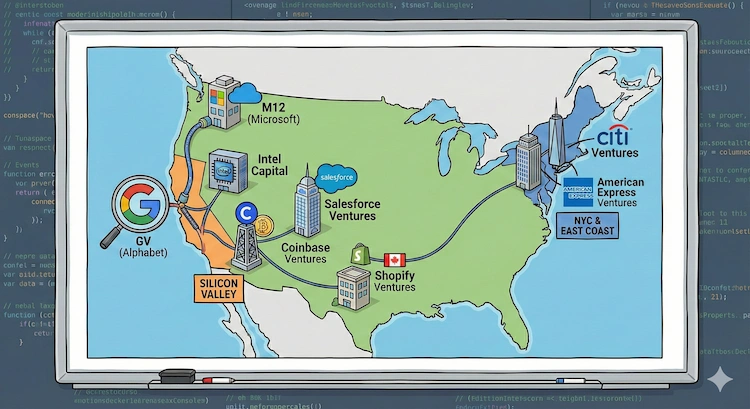
In startup funding, the spotlight usually falls on coastal CVCs. Those with the big names from Silicon Valley and New York with massive portfolios, polished logos, and promises of reach.
They’re well-known for a reason. But if you’re a founder looking for capital and an operational partner, the most aligned opportunities often sit in the center of the country: the Midwest and Middle America CVCs.
Founders who understand the difference in how CVCs operate across regions can unlock a level of strategic value that’s hard to find on the coasts. Let’s break down why.
Understanding the Coastal CVC Approach: Fast, Financial, and Broadly Thematic
Think of the GVs (Alphabet), M12 (Microsoft), Salesforce, Shopify, and Coinbase Ventures — CVCs launched by tech companies that grew up in hyper-competitive coastal markets. Their sophistication is undeniable. They move fast, operate like institutional VCs, and their investment models are largely built to generate financial return (IRR) across broad themes and categories. Sometimes, even investing in core products that are direct competitors to the mothership.
The “strategic support” they provide probably means brand validation, an advisory relationship, or the potential for a future acquisition. While all this is valuable for an entrepreneur, sometimes you might find yourself navigating a giant enterprise on your own, trying to locate champions, owners, budgets, and internal traction. The goal for these CVCs is often a high-multiple exit, driven by the intense, high-valuation markets they operate in.
Why does the strategic edge often get diluted on the coasts?
- Hyper-Competitive Markets: To compete for top deals, coastal CVCs must offer terms and flexibility that mimic institutional VCs.
- Diverse Investment Scope: Investing across many unrelated sectors makes deep, hands-on strategic integration difficult.
-Arm's-Length Relationship: Many founders in these markets prefer independence, leading CVCs based there to adopt a more hands-off approach.
The Midwest Advantage: CVCs Built for Real Change, Not Just Capital
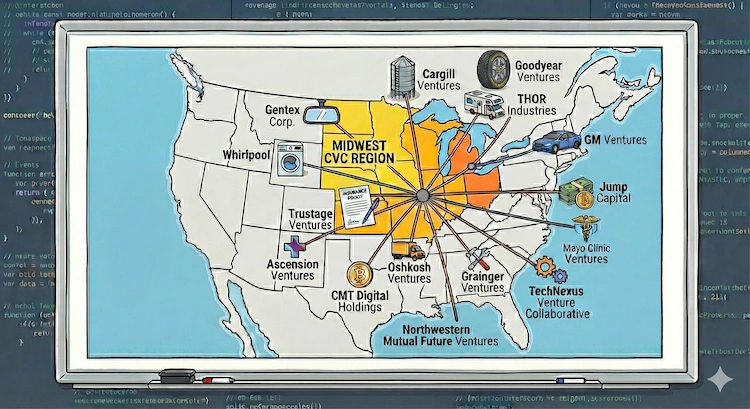
Middle America is home to companies that built (and still power) core parts of the American economy: manufacturing, agriculture, logistics, insurance, energy, and healthcare. These companies operate physical assets, global supply chains, and long-regulated environments. Plus, they’re under constant pressure to evolve and grow.
Midwest-based CVCs like 3M Ventures, GM Ventures, Mayo Clinic Ventures, Ascension Ventures, or TechNexus–THOR Holdings operate with a very different strategic mandate: to use venture investing to solve real operational challenges.
- Solving Core Business Problems: Leveraging equity investing to better engage with the leading startups that can dramatically improve their supply chain, enhance a manufacturing process, or navigate complex regulations.
- Becoming a "First Customer": These CVCs are often looking for technologies they can integrate, pilot, and ultimately deploy at scale within their own operations. Imagine having a Fortune 500 company as your first major client, providing real-world testing and validation.
- Driving Innovation Adoption: The goal is less about a quick flip and more about long-term integration for industry transformation. The parent company can provide access to internal R&D and engineering teams, as well as global distribution channels.
- Navigating Complex Industries: For startups in highly regulated sectors like defense, agriculture, or healthcare, the guidance and connections from a deeply embedded corporate partner can be invaluable.
This is where Midwest CVCs stand apart
Real-World Scale
The CVC's KPIs can be directly tied to the parent company's operational success, driving a deeper commitment to integrating your solution.
Expect access to subject matter experts, pilot programs, and a direct path to implement your technology within a massive organization.
While financial returns matter, the parent company's core strategic need often allows for a longer investment horizon, prioritizing successful adoption over rapid exit.
For a startup, partnering with a Midwest industrial giant means access to production lines, vast logistics networks, or extensive customer bases that can validate and scale your technology like no other.
Proof in the Numbers: The Midwest’s Strategic Difference
Looking at the 10 most active U.S. CVCs over the last five years and the top 10 most active Midwest-based CVCs over the last five years, according to PitchBook, shows the difference in investment mandate based on the parent company's core business.
The Coastal Mandate: Financial Returns & Ecosystem Dominance
The list of the most active U.S. CVCs is dominated by firms like Coinbase Ventures, GV (Alphabet), and Digital Currency Group. Their activity is defined by the high-velocity, high-valuation markets of the coasts and is predominantly structured to maximize financial returns or promote a software platform/ecosystem.
The Midwest Mandate: Operational Necessity & Hands-On Partnership
The Top 10 list of most active Midwest-based CVCs reinforces the Midwest advantage previously defined. It’s a majority roster of legacy industrials whose continued existence relies on solving complex, real-world operational challenges.
The value these firms provide — access to GM's next-gen battery tech, Mayo Clinic's patient data, or Ascension's procurement system — is the definition of strategic support that a purely financial check cannot buy.
The Advantage for Your Startup
If your startup needs real-world validation, deep industry expertise, or a major first customer to prove out your model, a Midwest CVC is often the most strategically aligned partner you’ll find. They offer capital and also bring true commercial pathways, hands-on operational support, and access to the scale, distribution, and customer relationships. For founders building in complex or industrial markets, this can be the difference between early traction and durable growth.
As a Venture Collaborative based in the heart of the Midwest, TechNexus has spent the last decade partnering with industry leaders like THOR Industries (RV), Brunswick (marine), Shure (audio), and AAR (aviation). We’ve invested in and collaborated with startups that touch factory floors, global supply chains, dealer networks, and end-customer experiences. What we consistently see inside these legacy companies is a desire for real strategic partnership with the startups they invest in — not symbolic collaboration, not “innovation theater,” but actual operational change.
For these organizations, venture investing is a way to accelerate transformation. A successful pilot or commercial deployment creates more enterprise value than a high-multiple exit ever could. That’s the difference. And it’s why founders looking to scale in industrial and commercial markets should consider Midwest CVCs as a true innovation partner.
Madelyn Rutter is currently the Senior Director of Collaboration at TechNexus Venture Collaborative, and a Midwest-born leader and community builder who thrives at the intersection of innovation, brand, and collaboration. She brings a rare blend of entrepreneurial grit and corporate fluency. Connecting ideas, people, and industries in ways that unlock new growth. Known for sparking collaboration that sticks and making big ideas feel doable.
Trending Stories

All Rights Reserved
Copyright 2025 Zeroto7 LLC
Powered by: