
Become a member & keep reading for free, or choose a paid membership.
Access all our content & email newsletter
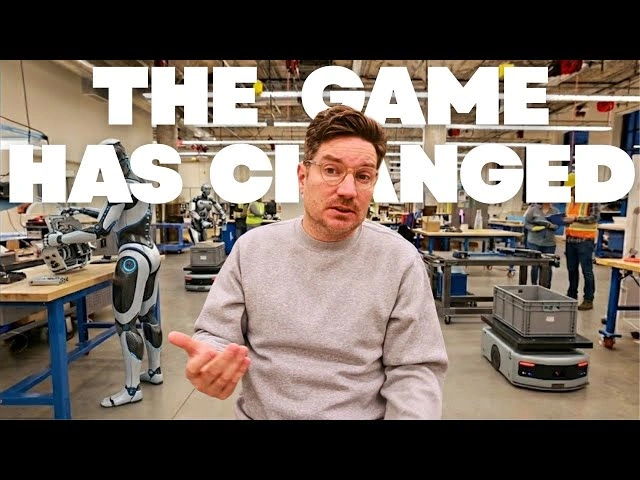
After moving to Detroit about two years ago to better understand modern manufacturing, Chris Nolte argues that change is happening fast - and that Artificial intelligence is one of the biggest accelerants, beyond the usual hype headlines. They frame this story as an on-the-ground look at what’s working, what isn’t, and why optimism about AI’s potential should sit alongside real caution about challenges.
To ground the discussion, the Chris defines common terms. AI is described as the broad discipline, with Machine learning contrasted against traditional rule-based programming: instead of writing a “rule book,” you show examples and the system learns patterns like an apprentice. Deep learning is positioned as what gives machines “senses” - the ability to see defects or hear abnormal machine sounds. Generative AI is associated with design use cases, while Large language model tools like ChatGPT and Gemini are described as “translators” between human language and machine code. He then introduces “physical AI” (noting it may not be an official term) as the moment a digital brain gets a body. e.g., a robot that can feel resistance and adjust its grip instead of blindly following coordinates.
From there, Chris talks about practical factory and engineering examples, while warning that hallucinations or blind spots could create safety hazards, so outputs must be treated carefully.
In design and inspection, he talks about new tools that can turn rough sketches into more build-ready drawings while highlighting Landing AI: instead of hand-coding rules, you can label a few photos (e.g., draw boxes around scratches) and the system learns.
Robotics is framed as a major bottleneck because industrial robots are often “scripted” and brittle. Citing work from an MIT lab on “liquid neural networks,” Chris talks about how a “liquid” brain could adapt to the environment and act more like a teammate.
He ends on coordination: robots and systems don’t naturally “talk,” so Chris talks about an “operating system” layer, and Machina Labs as an example using paired robots for incremental sheet forming to reduce reliance on massive stamped tooling. He points to Hyundai’s Singapore facility using flexible manufacturing cells (building different vehicle types in the same cells) and Durac converting CAD into linked work instructions that auto-update when designs change.
Chris closes with a key friction point: matching demand to real manufacturing capacity while positioning all of these examples as part of a broader shift lowering the barrier to building hardware.
Trending Stories

All Rights Reserved
Copyright 2025 Zeroto7 LLC
Powered by: